
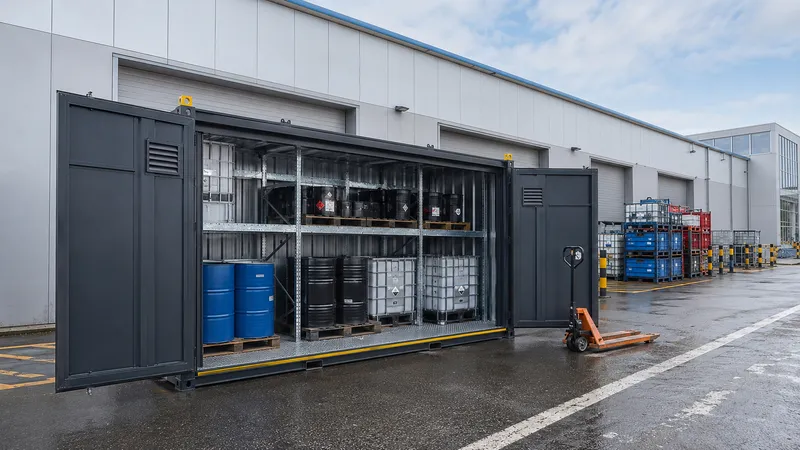
Buying a hazardous waste container is far more involved than choosing a size from a catalogue. Two waste streams that occupy the same volume may require completely different storage arrangements because of flammability, corrosivity, toxicity, reactivity, packaging and holding time. The correct starting point is therefore the waste and operational risk profile, not the product shell.
This guide explains how to build a requirement brief for an industrial site. It does not prescribe one universal model; it brings regulation, occupational safety, operation, maintenance and future capacity into one specification process. Final decisions should always be checked against the facility's current risk assessment and competent professional advice.
The best container is not the one with the most features, but the one that controls the real waste-flow risks in the right order.
Why the waste inventory comes first
Record code, physical form, packaging, hazard characteristics and peak monthly quantity for every stream. Capacity must reflect the highest accumulation between collections and a safe operating allowance, not only an annual average.
A sound decision starts by comparing desk assumptions with real site use. When waste inventory, compatibility groups, package type, quantity, holding period and site surroundings are made visible on one layout, interactions appear early. Added capacity may narrow an aisle; a larger fan in the wrong position may create a new exposure point. Every option should therefore be tested against operation, maintenance and emergency response, not judged in isolation.
The project team should test the arrangement during peak receiving, delayed dispatch, equipment failure and cleaning—not only on a normal day. For safe temporary storage of flammable, corrosive, toxic, oxidising or mutually reactive waste streams, safety allowance is controlled capacity for uncertainty and change, not simply unused space. Drawing dimensions should be checked with the actual packaging, pallets, trolleys or forklift envelope.
Once agreed, the decision becomes a measurable acceptance criterion. Replace “suitable” with a dimension, capacity, function, alarm, containment or access requirement. Manufacturer, procurement, environmental and HSE teams then read the same expectation, reducing interpretation at handover.
Four questions at this stage
- Is responsibility and decision authority defined?
- Are dimensions and capacity verified with site data?
- Is there an allowance for abnormal conditions?
- Can inspection and maintenance results be recorded?
Segregating incompatible wastes
Acids, alkalis, oxidisers, flammable liquids and reactive materials may require physical separation even within one enclosure. Partitions, shelving, spill trays and doors should prevent a release from reaching another compatibility group.
Site performance often depends on details surrounding the main equipment. If the relationship between waste inventory, compatibility groups, package type, quantity, holding period and site surroundings is missed, a well-built shell can remain weak inside a poor operating arrangement. Bringing production, maintenance, environment, HSE and procurement into the design review reduces these blind spots.
A practical method is to follow the current flow and ask at every touchpoint: who does what, with which equipment, and how often? The answers change door direction, shelf height, label position and cleaning space. A layout that naturally supports the correct behaviour is more resilient than a rule that depends only on memory.
After commissioning, review waste acceptance records, labels, safety data sheets, inspection checklists and incident records. If actual use differs from the plan, first ask whether layout, capacity or equipment makes the expected behaviour difficult. A good system reveals error and makes correction easier instead of hiding weak practice.
Four questions at this stage
- Is responsibility and decision authority defined?
- Are dimensions and capacity verified with site data?
- Is there an allowance for abnormal conditions?
- Can inspection and maintenance results be recorded?
Leak resistance and secondary containment
The container floor should become a second barrier if primary packaging fails. Sump geometry, grating load, emptying point and cleaning access need to be designed as one maintainable system.
There is rarely one universal dimension or equipment label for this decision. Waste properties, site surroundings and current duties need to be considered together. In safe temporary storage of flammable, corrosive, toxic, oxidising or mutually reactive waste streams, protective layers should each have a clear role so that failure of one does not remove every other control.
The quotation should contain this topic as an explicit line. Replace vague words such as “included” with material, capacity, performance, location, control method and limits. Two apparently equivalent options may differ in maintenance burden, spare-parts access or site use; total ownership is broader than purchase price.
Review continues after the project is complete. Reassess suitability when waste quantity, process, shifts, packaging or regulation changes. waste acceptance records, labels, safety data sheets, inspection checklists and incident records provide organisational memory showing when change began and which control needs improvement.
Four questions at this stage
- Is responsibility and decision authority defined?
- Are dimensions and capacity verified with site data?
- Is there an allowance for abnormal conditions?
- Can inspection and maintenance results be recorded?
Ventilation and climate conditions
Natural or mechanical ventilation should never be selected before vapour generation and explosive-atmosphere potential are assessed. Heating, cooling and electrical equipment belong to the same risk classification.
A sound decision starts by comparing desk assumptions with real site use. When waste inventory, compatibility groups, package type, quantity, holding period and site surroundings are made visible on one layout, interactions appear early. Added capacity may narrow an aisle; a larger fan in the wrong position may create a new exposure point. Every option should therefore be tested against operation, maintenance and emergency response, not judged in isolation.
The project team should test the arrangement during peak receiving, delayed dispatch, equipment failure and cleaning—not only on a normal day. For safe temporary storage of flammable, corrosive, toxic, oxidising or mutually reactive waste streams, safety allowance is controlled capacity for uncertainty and change, not simply unused space. Drawing dimensions should be checked with the actual packaging, pallets, trolleys or forklift envelope.
Once agreed, the decision becomes a measurable acceptance criterion. Replace “suitable” with a dimension, capacity, function, alarm, containment or access requirement. Manufacturer, procurement, environmental and HSE teams then read the same expectation, reducing interpretation at handover.
Four questions at this stage
- Is responsibility and decision authority defined?
- Are dimensions and capacity verified with site data?
- Is there an allowance for abnormal conditions?
- Can inspection and maintenance results be recorded?
Fire and explosion scenario
Passive fire resistance is only one layer. Detection, warning, suppression strategy, emergency access and the wider site fire plan must work together, with the extinguishing medium matched to the stored materials.
Site performance often depends on details surrounding the main equipment. If the relationship between waste inventory, compatibility groups, package type, quantity, holding period and site surroundings is missed, a well-built shell can remain weak inside a poor operating arrangement. Bringing production, maintenance, environment, HSE and procurement into the design review reduces these blind spots.
A practical method is to follow the current flow and ask at every touchpoint: who does what, with which equipment, and how often? The answers change door direction, shelf height, label position and cleaning space. A layout that naturally supports the correct behaviour is more resilient than a rule that depends only on memory.
After commissioning, review waste acceptance records, labels, safety data sheets, inspection checklists and incident records. If actual use differs from the plan, first ask whether layout, capacity or equipment makes the expected behaviour difficult. A good system reveals error and makes correction easier instead of hiding weak practice.
Four questions at this stage
- Is responsibility and decision authority defined?
- Are dimensions and capacity verified with site data?
- Is there an allowance for abnormal conditions?
- Can inspection and maintenance results be recorded?
Doors, aisles and operator ergonomics
Door clearance, thresholds, turning space, shelf height and drum-handling routes shape daily safety. Layouts that restrict escape or force awkward lifting should be rejected during design.
There is rarely one universal dimension or equipment label for this decision. Waste properties, site surroundings and current duties need to be considered together. In safe temporary storage of flammable, corrosive, toxic, oxidising or mutually reactive waste streams, protective layers should each have a clear role so that failure of one does not remove every other control.
The quotation should contain this topic as an explicit line. Replace vague words such as “included” with material, capacity, performance, location, control method and limits. Two apparently equivalent options may differ in maintenance burden, spare-parts access or site use; total ownership is broader than purchase price.
Review continues after the project is complete. Reassess suitability when waste quantity, process, shifts, packaging or regulation changes. waste acceptance records, labels, safety data sheets, inspection checklists and incident records provide organisational memory showing when change began and which control needs improvement.
Four questions at this stage
- Is responsibility and decision authority defined?
- Are dimensions and capacity verified with site data?
- Is there an allowance for abnormal conditions?
- Can inspection and maintenance results be recorded?
Site position and surrounding exposure
Review the relationship with buildings, vehicle routes, storm-water lines, pedestrians and emergency response. Ground capacity, slope, flood exposure and required safety distances should be recorded during the survey.
A sound decision starts by comparing desk assumptions with real site use. When waste inventory, compatibility groups, package type, quantity, holding period and site surroundings are made visible on one layout, interactions appear early. Added capacity may narrow an aisle; a larger fan in the wrong position may create a new exposure point. Every option should therefore be tested against operation, maintenance and emergency response, not judged in isolation.
The project team should test the arrangement during peak receiving, delayed dispatch, equipment failure and cleaning—not only on a normal day. For safe temporary storage of flammable, corrosive, toxic, oxidising or mutually reactive waste streams, safety allowance is controlled capacity for uncertainty and change, not simply unused space. Drawing dimensions should be checked with the actual packaging, pallets, trolleys or forklift envelope.
Once agreed, the decision becomes a measurable acceptance criterion. Replace “suitable” with a dimension, capacity, function, alarm, containment or access requirement. Manufacturer, procurement, environmental and HSE teams then read the same expectation, reducing interpretation at handover.
Four questions at this stage
- Is responsibility and decision authority defined?
- Are dimensions and capacity verified with site data?
- Is there an allowance for abnormal conditions?
- Can inspection and maintenance results be recorded?
Specification and bid comparison
Compare bids on the same matrix: materials, coating, sump volume, doors, ventilation rate, electrical equipment, documentation and warranty—not only purchase price and external dimensions.
Site performance often depends on details surrounding the main equipment. If the relationship between waste inventory, compatibility groups, package type, quantity, holding period and site surroundings is missed, a well-built shell can remain weak inside a poor operating arrangement. Bringing production, maintenance, environment, HSE and procurement into the design review reduces these blind spots.
A practical method is to follow the current flow and ask at every touchpoint: who does what, with which equipment, and how often? The answers change door direction, shelf height, label position and cleaning space. A layout that naturally supports the correct behaviour is more resilient than a rule that depends only on memory.
After commissioning, review waste acceptance records, labels, safety data sheets, inspection checklists and incident records. If actual use differs from the plan, first ask whether layout, capacity or equipment makes the expected behaviour difficult. A good system reveals error and makes correction easier instead of hiding weak practice.
Four questions at this stage
- Is responsibility and decision authority defined?
- Are dimensions and capacity verified with site data?
- Is there an allowance for abnormal conditions?
- Can inspection and maintenance results be recorded?
Acceptance, training and commissioning
At delivery, function-test doors, locks, fans, alarms, drainage and containment in addition to visual inspection. Operator training should cover capacity limits, prohibited wastes and emergency steps.
There is rarely one universal dimension or equipment label for this decision. Waste properties, site surroundings and current duties need to be considered together. In safe temporary storage of flammable, corrosive, toxic, oxidising or mutually reactive waste streams, protective layers should each have a clear role so that failure of one does not remove every other control.
The quotation should contain this topic as an explicit line. Replace vague words such as “included” with material, capacity, performance, location, control method and limits. Two apparently equivalent options may differ in maintenance burden, spare-parts access or site use; total ownership is broader than purchase price.
Review continues after the project is complete. Reassess suitability when waste quantity, process, shifts, packaging or regulation changes. waste acceptance records, labels, safety data sheets, inspection checklists and incident records provide organisational memory showing when change began and which control needs improvement.
Four questions at this stage
- Is responsibility and decision authority defined?
- Are dimensions and capacity verified with site data?
- Is there an allowance for abnormal conditions?
- Can inspection and maintenance results be recorded?
Maintenance and change control
Reassess suitability whenever the process, waste stream or quantity changes. Inspect filters, seals, coatings, sensors and the containment sump at planned intervals and retain the results.
A sound decision starts by comparing desk assumptions with real site use. When waste inventory, compatibility groups, package type, quantity, holding period and site surroundings are made visible on one layout, interactions appear early. Added capacity may narrow an aisle; a larger fan in the wrong position may create a new exposure point. Every option should therefore be tested against operation, maintenance and emergency response, not judged in isolation.
The project team should test the arrangement during peak receiving, delayed dispatch, equipment failure and cleaning—not only on a normal day. For safe temporary storage of flammable, corrosive, toxic, oxidising or mutually reactive waste streams, safety allowance is controlled capacity for uncertainty and change, not simply unused space. Drawing dimensions should be checked with the actual packaging, pallets, trolleys or forklift envelope.
Once agreed, the decision becomes a measurable acceptance criterion. Replace “suitable” with a dimension, capacity, function, alarm, containment or access requirement. Manufacturer, procurement, environmental and HSE teams then read the same expectation, reducing interpretation at handover.
Four questions at this stage
- Is responsibility and decision authority defined?
- Are dimensions and capacity verified with site data?
- Is there an allowance for abnormal conditions?
- Can inspection and maintenance results be recorded?
Final check before the specification is issued
The meeting should end with more than “we need a hazardous waste container.” Write accepted and prohibited wastes, capacity, packaging, internal layout, secondary containment, ventilation, fire strategy, electrical equipment, doors and access, cleaning, maintenance, documentation and acceptance criteria as explicit clauses. Identifying the data and assumptions behind each clause makes bid comparison more reliable.
Common weaknesses include selecting by external size alone, mixing incompatible streams, leaving secondary containment uncalculated, guessing ventilation needs and neglecting maintenance access. These usually arise because decisions remain scattered across teams, not because anyone intends to create risk. A shared site plan, waste inventory and responsibility table reduce that fragmentation. Compare not only purchase price but the cost of wrong capacity, downtime, cleaning, maintenance and later modifications.
Finally ask whether the control can be sustained in daily operation. A layout that adds unnecessary steps, cannot be cleaned, hides inspection points or gives no fault feedback will weaken over time. Good engineering makes safe behaviour the easiest behaviour and keeps performance visible through waste acceptance records, labels, safety data sheets, inspection checklists and incident records.
Frequently asked questions
How is hazardous-waste container size calculated?
Must every unit be explosion protected?
What fire-resistance period is required?
Standard model or custom design?
Regulatory note: This is general technical information, not legal or project-specific engineering advice. Regulations and technical requirements may change; verify current official texts, facility permits and competent professional advice before implementation.