
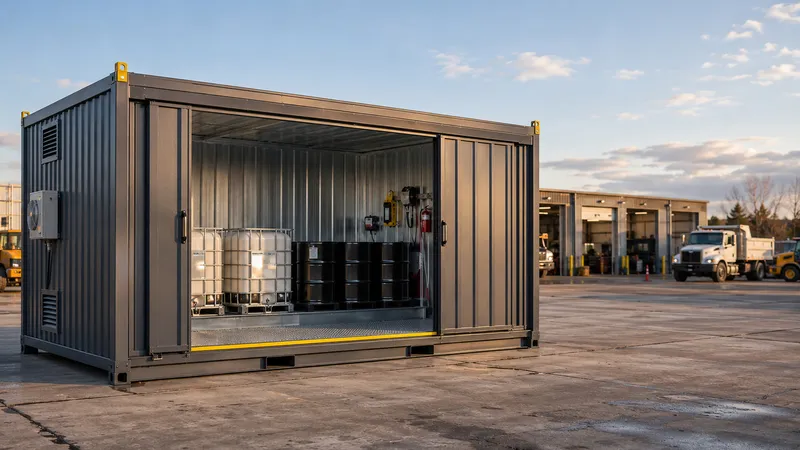
Waste oil often arises in small quantities across workshops and production lines, but a poor collection arrangement can turn those small volumes into a major environmental and operational risk. Open containers, unlabelled canisters, unattended funnels or a late discovery of a full tank can create slip hazards, contaminate storm water, increase fire load and reduce recovery value.
A safe system is more than a tank. The route from each generation point, pump and hose arrangement, secondary containment, overfill prevention, separation of oil streams, records and cleaning procedure must be designed together. This guide organises the decisions from survey through commissioning.
The best container is not the one with the most features, but the one that controls the real waste-flow risks in the right order.
Map the waste-oil flow
Map every generation point, oil type, daily volume and transfer method. If small intermediate cans are used at remote points, their labels, lids and transport routes need the same level of control as the main station.
A sound decision starts by comparing desk assumptions with real site use. When oil streams, daily quantity, tank or package selection, transfer route, pump rate, collection interval and site drainage are made visible on one layout, interactions appear early. Added capacity may narrow an aisle; a larger fan in the wrong position may create a new exposure point. Every option should therefore be tested against operation, maintenance and emergency response, not judged in isolation.
The project team should test the arrangement during peak receiving, delayed dispatch, equipment failure and cleaning—not only on a normal day. For closed, segregated and leak-resistant temporary storage of mineral waste oils from maintenance and production, safety allowance is controlled capacity for uncertainty and change, not simply unused space. Drawing dimensions should be checked with the actual packaging, pallets, trolleys or forklift envelope.
Once agreed, the decision becomes a measurable acceptance criterion. Replace “suitable” with a dimension, capacity, function, alarm, containment or access requirement. Manufacturer, procurement, environmental and HSE teams then read the same expectation, reducing interpretation at handover.
Four questions at this stage
- Is responsibility and decision authority defined?
- Are dimensions and capacity verified with site data?
- Is there an allowance for abnormal conditions?
- Can inspection and maintenance results be recorded?
Tank, drum or IBC
A tank can suit continuous high volume; drums or IBCs may better separate variable streams. The decision must include emptying equipment, collection-vehicle connection and site manoeuvring space.
Site performance often depends on details surrounding the main equipment. If the relationship between oil streams, daily quantity, tank or package selection, transfer route, pump rate, collection interval and site drainage is missed, a well-built shell can remain weak inside a poor operating arrangement. Bringing production, maintenance, environment, HSE and procurement into the design review reduces these blind spots.
A practical method is to follow the current flow and ask at every touchpoint: who does what, with which equipment, and how often? The answers change door direction, shelf height, label position and cleaning space. A layout that naturally supports the correct behaviour is more resilient than a rule that depends only on memory.
After commissioning, review tank-level logs, transfer documents, pump maintenance records, leak checks, labels and cleaning records. If actual use differs from the plan, first ask whether layout, capacity or equipment makes the expected behaviour difficult. A good system reveals error and makes correction easier instead of hiding weak practice.
Four questions at this stage
- Is responsibility and decision authority defined?
- Are dimensions and capacity verified with site data?
- Is there an allowance for abnormal conditions?
- Can inspection and maintenance results be recorded?
Secondary containment and drips
Tank, pump, valves and every connection belong in the spill scenario. A sump, grating and drip trays should stop routine losses spreading across the floor and allow simple cleaning.
There is rarely one universal dimension or equipment label for this decision. Waste properties, site surroundings and current duties need to be considered together. In closed, segregated and leak-resistant temporary storage of mineral waste oils from maintenance and production, protective layers should each have a clear role so that failure of one does not remove every other control.
The quotation should contain this topic as an explicit line. Replace vague words such as “included” with material, capacity, performance, location, control method and limits. Two apparently equivalent options may differ in maintenance burden, spare-parts access or site use; total ownership is broader than purchase price.
Review continues after the project is complete. Reassess suitability when waste quantity, process, shifts, packaging or regulation changes. tank-level logs, transfer documents, pump maintenance records, leak checks, labels and cleaning records provide organisational memory showing when change began and which control needs improvement.
Four questions at this stage
- Is responsibility and decision authority defined?
- Are dimensions and capacity verified with site data?
- Is there an allowance for abnormal conditions?
- Can inspection and maintenance results be recorded?
Pump, hose and filling point
Pump flow should avoid splash and match receiving capacity. A self-closing nozzle, hose reel, drip cup and closed funnel strengthen operating discipline.
A sound decision starts by comparing desk assumptions with real site use. When oil streams, daily quantity, tank or package selection, transfer route, pump rate, collection interval and site drainage are made visible on one layout, interactions appear early. Added capacity may narrow an aisle; a larger fan in the wrong position may create a new exposure point. Every option should therefore be tested against operation, maintenance and emergency response, not judged in isolation.
The project team should test the arrangement during peak receiving, delayed dispatch, equipment failure and cleaning—not only on a normal day. For closed, segregated and leak-resistant temporary storage of mineral waste oils from maintenance and production, safety allowance is controlled capacity for uncertainty and change, not simply unused space. Drawing dimensions should be checked with the actual packaging, pallets, trolleys or forklift envelope.
Once agreed, the decision becomes a measurable acceptance criterion. Replace “suitable” with a dimension, capacity, function, alarm, containment or access requirement. Manufacturer, procurement, environmental and HSE teams then read the same expectation, reducing interpretation at handover.
Four questions at this stage
- Is responsibility and decision authority defined?
- Are dimensions and capacity verified with site data?
- Is there an allowance for abnormal conditions?
- Can inspection and maintenance results be recorded?
Level monitoring and overfill prevention
A high-level alarm and operating capacity limit can complement visual indication. Collection should be triggered before the safe level is approached, not at the last moment.
Site performance often depends on details surrounding the main equipment. If the relationship between oil streams, daily quantity, tank or package selection, transfer route, pump rate, collection interval and site drainage is missed, a well-built shell can remain weak inside a poor operating arrangement. Bringing production, maintenance, environment, HSE and procurement into the design review reduces these blind spots.
A practical method is to follow the current flow and ask at every touchpoint: who does what, with which equipment, and how often? The answers change door direction, shelf height, label position and cleaning space. A layout that naturally supports the correct behaviour is more resilient than a rule that depends only on memory.
After commissioning, review tank-level logs, transfer documents, pump maintenance records, leak checks, labels and cleaning records. If actual use differs from the plan, first ask whether layout, capacity or equipment makes the expected behaviour difficult. A good system reveals error and makes correction easier instead of hiding weak practice.
Four questions at this stage
- Is responsibility and decision authority defined?
- Are dimensions and capacity verified with site data?
- Is there an allowance for abnormal conditions?
- Can inspection and maintenance results be recorded?
Keep oil streams separate
Mineral oil, emulsions, solvent-bearing liquids and used cooking oil are different streams. Mixing can alter both hazard profile and recovery route, so the acceptance list must be explicit.
There is rarely one universal dimension or equipment label for this decision. Waste properties, site surroundings and current duties need to be considered together. In closed, segregated and leak-resistant temporary storage of mineral waste oils from maintenance and production, protective layers should each have a clear role so that failure of one does not remove every other control.
The quotation should contain this topic as an explicit line. Replace vague words such as “included” with material, capacity, performance, location, control method and limits. Two apparently equivalent options may differ in maintenance burden, spare-parts access or site use; total ownership is broader than purchase price.
Review continues after the project is complete. Reassess suitability when waste quantity, process, shifts, packaging or regulation changes. tank-level logs, transfer documents, pump maintenance records, leak checks, labels and cleaning records provide organisational memory showing when change began and which control needs improvement.
Four questions at this stage
- Is responsibility and decision authority defined?
- Are dimensions and capacity verified with site data?
- Is there an allowance for abnormal conditions?
- Can inspection and maintenance results be recorded?
Outdoor weather and drainage
Rainwater inside secondary containment reduces available spill capacity. Roofs, thresholds, platform slope and controlled drainage should keep clean water out of the waste-oil system.
A sound decision starts by comparing desk assumptions with real site use. When oil streams, daily quantity, tank or package selection, transfer route, pump rate, collection interval and site drainage are made visible on one layout, interactions appear early. Added capacity may narrow an aisle; a larger fan in the wrong position may create a new exposure point. Every option should therefore be tested against operation, maintenance and emergency response, not judged in isolation.
The project team should test the arrangement during peak receiving, delayed dispatch, equipment failure and cleaning—not only on a normal day. For closed, segregated and leak-resistant temporary storage of mineral waste oils from maintenance and production, safety allowance is controlled capacity for uncertainty and change, not simply unused space. Drawing dimensions should be checked with the actual packaging, pallets, trolleys or forklift envelope.
Once agreed, the decision becomes a measurable acceptance criterion. Replace “suitable” with a dimension, capacity, function, alarm, containment or access requirement. Manufacturer, procurement, environmental and HSE teams then read the same expectation, reducing interpretation at handover.
Four questions at this stage
- Is responsibility and decision authority defined?
- Are dimensions and capacity verified with site data?
- Is there an allowance for abnormal conditions?
- Can inspection and maintenance results be recorded?
Fire load and ignition sources
Do not assume a single fire profile without reviewing oil characteristics and contaminants. Electrical panels, hot work, vehicle exhausts and smoking areas need to be checked on the layout.
Site performance often depends on details surrounding the main equipment. If the relationship between oil streams, daily quantity, tank or package selection, transfer route, pump rate, collection interval and site drainage is missed, a well-built shell can remain weak inside a poor operating arrangement. Bringing production, maintenance, environment, HSE and procurement into the design review reduces these blind spots.
A practical method is to follow the current flow and ask at every touchpoint: who does what, with which equipment, and how often? The answers change door direction, shelf height, label position and cleaning space. A layout that naturally supports the correct behaviour is more resilient than a rule that depends only on memory.
After commissioning, review tank-level logs, transfer documents, pump maintenance records, leak checks, labels and cleaning records. If actual use differs from the plan, first ask whether layout, capacity or equipment makes the expected behaviour difficult. A good system reveals error and makes correction easier instead of hiding weak practice.
Four questions at this stage
- Is responsibility and decision authority defined?
- Are dimensions and capacity verified with site data?
- Is there an allowance for abnormal conditions?
- Can inspection and maintenance results be recorded?
Handover, records and authorised routes
Comparing outgoing quantity with tank-level logs can reveal loss, leakage or record errors. Handover must follow current rules and authorised recipient requirements.
There is rarely one universal dimension or equipment label for this decision. Waste properties, site surroundings and current duties need to be considered together. In closed, segregated and leak-resistant temporary storage of mineral waste oils from maintenance and production, protective layers should each have a clear role so that failure of one does not remove every other control.
The quotation should contain this topic as an explicit line. Replace vague words such as “included” with material, capacity, performance, location, control method and limits. Two apparently equivalent options may differ in maintenance burden, spare-parts access or site use; total ownership is broader than purchase price.
Review continues after the project is complete. Reassess suitability when waste quantity, process, shifts, packaging or regulation changes. tank-level logs, transfer documents, pump maintenance records, leak checks, labels and cleaning records provide organisational memory showing when change began and which control needs improvement.
Four questions at this stage
- Is responsibility and decision authority defined?
- Are dimensions and capacity verified with site data?
- Is there an allowance for abnormal conditions?
- Can inspection and maintenance results be recorded?
Cleaning and preventive maintenance
Valves, hoses, seals, pump, level indicator and sump belong on the planned inspection list. Correcting a minor seep or loose connection early can prevent a major spill and downtime.
A sound decision starts by comparing desk assumptions with real site use. When oil streams, daily quantity, tank or package selection, transfer route, pump rate, collection interval and site drainage are made visible on one layout, interactions appear early. Added capacity may narrow an aisle; a larger fan in the wrong position may create a new exposure point. Every option should therefore be tested against operation, maintenance and emergency response, not judged in isolation.
The project team should test the arrangement during peak receiving, delayed dispatch, equipment failure and cleaning—not only on a normal day. For closed, segregated and leak-resistant temporary storage of mineral waste oils from maintenance and production, safety allowance is controlled capacity for uncertainty and change, not simply unused space. Drawing dimensions should be checked with the actual packaging, pallets, trolleys or forklift envelope.
Once agreed, the decision becomes a measurable acceptance criterion. Replace “suitable” with a dimension, capacity, function, alarm, containment or access requirement. Manufacturer, procurement, environmental and HSE teams then read the same expectation, reducing interpretation at handover.
Four questions at this stage
- Is responsibility and decision authority defined?
- Are dimensions and capacity verified with site data?
- Is there an allowance for abnormal conditions?
- Can inspection and maintenance results be recorded?
Final check before the specification is issued
The meeting should end with more than “we need a waste oil storage system.” Write accepted and prohibited wastes, capacity, packaging, internal layout, secondary containment, ventilation, fire strategy, electrical equipment, doors and access, cleaning, maintenance, documentation and acceptance criteria as explicit clauses. Identifying the data and assumptions behind each clause makes bid comparison more reliable.
Common weaknesses include mixing oils without review, leaving an open funnel, omitting high-level protection, dragging hoses over the floor, allowing rainwater into the sump and failing to plan collection capacity. These usually arise because decisions remain scattered across teams, not because anyone intends to create risk. A shared site plan, waste inventory and responsibility table reduce that fragmentation. Compare not only purchase price but the cost of wrong capacity, downtime, cleaning, maintenance and later modifications.
Finally ask whether the control can be sustained in daily operation. A layout that adds unnecessary steps, cannot be cleaned, hides inspection points or gives no fault feedback will weaken over time. Good engineering makes safe behaviour the easiest behaviour and keeps performance visible through tank-level logs, transfer documents, pump maintenance records, leak checks, labels and cleaning records.
Frequently asked questions
How full should a waste-oil tank be?
Can different engine oils be mixed?
What happens to rainwater in a spill sump?
What matters most in pump selection?
Regulatory note: This is general technical information, not legal or project-specific engineering advice. Regulations and technical requirements may change; verify current official texts, facility permits and competent professional advice before implementation.